
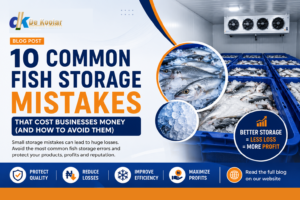
A Complete Guide to Preserving Fish Quality, Reducing Spoilage, and Maximizing Profit
Fish is one of the most perishable food products in the world. From the moment it is harvested, its quality begins to decline if it is not stored under the right conditions. For fish farmers, seafood processors, distributors, exporters, cold store operators, supermarkets, restaurants, and retailers, proper fish storage is essential to maintaining freshness, ensuring food safety, and protecting profitability.
Unfortunately, many businesses unknowingly make costly storage mistakes that lead to spoilage, customer complaints, financial losses, and reduced shelf life.
In this article, we highlight the most common fish storage mistakes and explain how proper cold chain management can help your business reduce waste, improve product quality, and increase customer satisfaction.
Why Proper Fish Storage Matters
Fresh fish is highly sensitive to temperature changes and bacterial growth. Poor storage practices can quickly affect its texture, taste, appearance, and nutritional value.
Effective cold storage helps businesses:
- Maintain product freshness
- Extend shelf life
- Reduce spoilage
- Preserve food safety
- Meet regulatory requirements
- Improve customer confidence
- Increase profitability
A reliable cold chain is not just a storage solution, it is a critical investment in business success.
Mistake 1: Delaying Refrigeration after Harvest
One of the biggest mistakes is leaving freshly harvested fish exposed to ambient temperatures for too long.
Every minute without proper cooling allows bacteria to multiply and accelerates product deterioration.
Best Practice
Fish should be chilled or blast frozen immediately after harvest or processing to preserve freshness and maintain quality.
The faster the fish is preserved, the longer its shelf life.
Mistake 2: Storing Fish at the Wrong Temperature
Temperature control is the foundation of successful fish storage.
Many businesses use incorrect storage temperatures, causing rapid spoilage.
General guidelines include:
- Fresh fish: close to 0°C using ice or chilled storage
- Frozen fish: typically around -18°C or below for long-term storage
Maintaining consistent temperatures is more important than simply reaching them.
Mistake 3: Frequent Door Opening
Every time a cold room door is opened, warm air enters while cold air escapes.
This forces the refrigeration system to work harder and causes temperature fluctuations that can affect fish quality.
Best Practice
- Minimize unnecessary door openings.
- Organize inventory for quick access.
- Train staff on efficient loading and unloading procedures.
Mistake 4: Overloading the Cold Room
Many operators assume filling every available space increases efficiency.
In reality, overcrowding blocks airflow, creating uneven cooling throughout the cold room.
Some fish may remain warmer than others, increasing the risk of spoilage.
Best Practice
Allow adequate space between products to ensure proper air circulation.
Mistake 5: Using Poor Quality Insulation
A poorly insulated cold room struggles to maintain the required storage temperature.
This leads to:
- Increased electricity consumption
- Higher operating costs
- Compressor overwork
- Temperature instability
High-quality insulated panels and properly sealed doors are essential for efficient fish storage.
Mistake 6: Refreezing Thawed Fish
Once frozen fish has thawed completely, refreezing can negatively affect its texture, moisture content, and overall quality.
Repeated freeze-thaw cycles may also increase food safety risks.
Best Practice
Only thaw the quantity needed for immediate use.
Avoid repeated freezing and thawing whenever possible.
Mistake 7: Poor Hygiene Practices
Even the best refrigeration system cannot compensate for poor sanitation.
Dirty storage areas may contribute to contamination and unpleasant odours.
Best Practice
Maintain strict hygiene by:
- Cleaning storage surfaces regularly
- Sanitizing equipment
- Removing damaged packaging
- Practicing proper food handling procedures
Mistake 8: Ignoring Equipment Maintenance
A neglected refrigeration system often performs inefficiently.
Dirty condensers, worn door seals, blocked evaporators, or incorrect refrigerant levels can increase energy consumption and reduce cooling performance.
Best Practice
Implement a preventive maintenance schedule that includes:
- Compressor inspections
- Refrigerant checks
- Condenser cleaning
- Evaporator maintenance
- Temperature calibration
Regular servicing reduces downtime and extends equipment life.
Mistake 9: Not Monitoring Temperature Continuously
Some businesses only check the cold room temperature occasionally.
Temperature fluctuations can go unnoticed, leading to significant product losses.
Best Practice
Use reliable temperature monitoring systems and keep regular records to identify potential issues before they become costly.
Modern digital monitoring solutions provide greater visibility and control.
Mistake 10: Choosing the Wrong Cold Storage Equipment
Not every refrigeration system is suitable for fish storage.
Using an undersized, oversized, or poorly designed cold room can result in:
- Higher electricity bills
- Uneven cooling
- Increased maintenance
- Reduced product quality
Best Practice
Invest in a professionally designed cold room tailored to your:
- Daily production volume
- Product type
- Storage duration
- Available space
- Business growth plans
A customized solution delivers better efficiency and long-term value.
The Role of Blast Freezers in Fish Storage
For businesses handling large quantities of fish, blast freezers play a crucial role in preserving quality.
Unlike conventional freezers, blast freezers rapidly remove heat from freshly processed fish, helping to:
- Preserve texture
- Retain natural flavor
- Reduce ice crystal formation
- Extend storage life
- Maintain product appearance
Rapid freezing is especially important for seafood intended for export or long-term storage.
Benefits of Proper Fish Cold Storage
Businesses that implement good cold storage practices can enjoy:
Reduced Product Losses
Lower spoilage means higher profits.
Improved Food Safety
Consistent temperature control helps maintain product integrity.
Longer Shelf Life
Fish remains fresh for longer periods when stored correctly.
Lower Operating Costs
Efficient refrigeration reduces energy consumption and maintenance expenses.
Increased Customer Satisfaction
Fresh, high-quality fish builds customer trust and repeat business.
Better Business Reputation
Reliable product quality strengthens your brand in the marketplace.
Why Choose De koolar Nigeria Limited?
At De koolar Nigeria Limited, we understand the unique refrigeration requirements of the seafood industry.
We design and manufacture:
- Fish Cold Rooms
- Seafood Chiller Rooms
- Blast Freezers
- Commercial Cold Storage Facilities
- Solar-Powered Cold Rooms
- Industrial Refrigeration Systems
Our cold chain solutions are engineered to deliver:
- Precise temperature control
- Energy efficiency
- High-performance insulation
- Reliable operation
- Long equipment lifespan
- Professional installation and after-sales support
Whether you’re a fish farmer, seafood processor, distributor, exporter, supermarket, or cold storage operator, we provide customized solutions that help protect your products and improve your business performance.
Conclusion
Fish storage is far more than simply placing products in a freezer. Every stage of the cold chain from harvest and rapid cooling to storage and maintenance plays a vital role in preserving freshness, ensuring food safety, and maximizing profitability.
Avoiding common mistakes such as improper temperature control, overcrowding, poor hygiene, delayed refrigeration, and inadequate maintenance can significantly reduce spoilage and improve operational efficiency.
Investing in a professionally designed cold storage solution is one of the smartest decisions a seafood business can make. It protects product quality, reduces operating costs, and gives customers confidence in every purchase.
Protect Your Seafood Investment with De koolar
If you’re planning to build or upgrade a fish cold room, blast freezer, or seafood refrigeration facility, De koolar Nigeria Limited has the expertise to deliver a solution tailored to your operational needs.
Contact De koolar Nigeria Limited today and discover how our innovative cold chain solutions can help you reduce spoilage, preserve freshness, and grow your seafood business with confidence.