
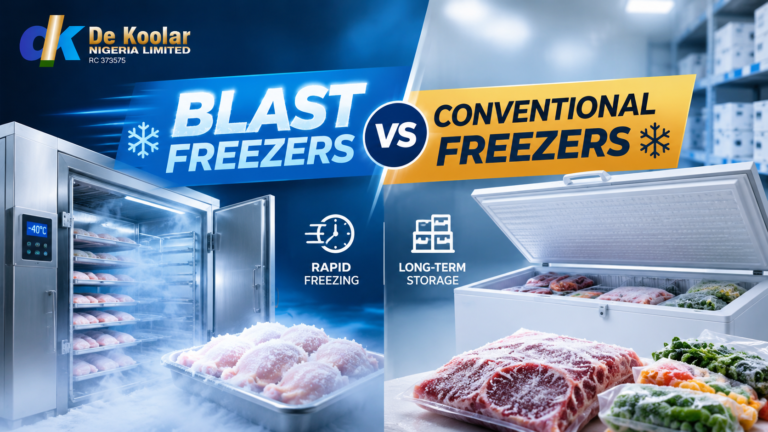
When it comes to preserving food and temperature-sensitive products, freezing is more than simply putting products into a cold environment. How quickly a product is frozen, how consistently the required temperature is maintained, and how the freezing system is designed can all affect the efficiency of a cold-chain operation.
This is why businesses involved in poultry processing, meat processing, fisheries, food production, agriculture and other temperature-sensitive industries often need to choose between different types of freezing equipment.
Two commonly discussed options are blast freezers and conventional freezers.
Although both are designed to keep products frozen or help bring products to low temperatures, they are not designed for exactly the same purpose.
So, what is the difference between a blast freezer and a conventional freezer? When does a business need a blast freezer? And how do you determine the right industrial freezer solution for your operation?
Let’s examine the key differences.
What Is a Conventional Freezer?
A conventional freezer is primarily designed to maintain products at frozen temperatures.
It removes heat from products and keeps the storage environment sufficiently cold to prevent frozen products from thawing. Conventional freezers are commonly found in restaurants, supermarkets, hotels, homes and businesses that primarily need to store products that have already been frozen.
For example, a business may purchase frozen chicken from a processor and place it inside a freezer for storage until it is distributed or sold.
The freezer’s primary responsibility is maintaining the frozen condition of the product.
This makes conventional freezer systems suitable for businesses whose main requirement is frozen storage rather than rapid freezing of large quantities of fresh products.
What Is a Blast Freezer?
A blast freezer is designed to freeze products rapidly by circulating very cold air at high velocity around the product.
Instead of simply maintaining products that are already frozen, a blast freezer is designed to remove heat from fresh or chilled products quickly and bring them down to the required frozen condition.
This makes blast freezers particularly useful in commercial and industrial food-processing operations.
They can be used for products such as:
- Poultry
- Meat
- Fish and seafood
- Processed foods
- Agricultural produce
- Bakery products
- Other temperature-sensitive products
The exact freezing performance depends on factors such as product type, product quantity, starting temperature, target temperature, product arrangement, airflow and refrigeration capacity.
In other words, a blast freezer is not simply a “colder freezer.” It is a freezing system designed around rapid heat removal and controlled freezing.
Blast Freezer vs Conventional Freezer: What's the Difference?
The simplest way to understand the difference is to look at their primary functions.
| Feature | Blast Freezer | Conventional Freezer |
|---|---|---|
| Primary purpose | Rapid freezing | Frozen storage |
| Freezing speed | Designed for rapid freezing | Generally slower |
| Product entering system | Fresh or chilled products | Usually already-frozen products |
| Air movement | High-velocity circulation | Standard circulation |
| Typical application | Food processing and industrial operations | Storage and inventory holding |
| Throughput | Suitable for higher freezing demands | Primarily focused on storage |
| System design | Designed around freezing cycles and heat removal | Designed around maintaining temperature |
| Investment | Generally higher | Generally lower |
Neither system is automatically suitable for every business.
The right choice depends on what the business is trying to achieve.
If your operation needs to rapidly freeze freshly processed products, a blast freezer may be appropriate.
If your primary requirement is to store products that are already frozen, a conventional freezer may be sufficient.
Why Does Freezing Speed Matter?
Freezing speed can have an important role in food preservation.
When a product freezes, water within the product forms ice crystals. The rate at which freezing takes place can influence the size and distribution of these ice crystals.
Rapid freezing generally promotes the formation of smaller ice crystals compared with slower freezing under comparable conditions.
This is one reason blast freezing is widely used in commercial food-processing operations where product quality and processing efficiency are important considerations.
For businesses, the objective isn’t simply to make a product cold. The objective is to establish a controlled freezing process that matches the requirements of the product and production operation.
For example, a poultry processor may process hundreds or thousands of kilograms of product during a production cycle. Leaving freshly processed products in a conventional storage freezer and expecting it to perform the same function as a purpose-designed blast freezer can create operational challenges.
The freezing process needs to match the production volume.
When Does Your Business Need a Blast Freezer?
A blast freezer may be worth considering if your business regularly handles significant quantities of fresh or chilled products that need to be frozen within a defined period.
You may need to evaluate a blast freezing solution if:
- You process large quantities of poultry, meat or fish.
- Your existing freezer cannot keep up with production.
- You need to freeze products shortly after processing.
- Freezing has become a bottleneck in your production process.
- You are expanding production capacity.
- You supply supermarkets, distributors or institutional customers.
- You need more predictable freezing cycles.
- You want to integrate freezing into a larger cold-chain operation.
For example, a poultry processor may have sufficient processing capacity but inadequate freezing capacity. The result can be a bottleneck between processing and storage.
Increasing freezing capacity can therefore become an important part of expanding the operation.
When Is a Conventional Freezer Enough?
Not every business needs a blast freezer.
A conventional freezer may be appropriate when the business primarily stores products that are already frozen.
Consider a supermarket receiving frozen products from suppliers. Its main requirement may be to keep those products frozen until they are sold.
Similarly, a restaurant or food-service business with relatively low freezing requirements may not need an industrial blast freezing system.
A conventional freezer can therefore make sense when:
- Products are already frozen before entering storage.
- The primary requirement is frozen inventory holding.
- Freezing volumes are relatively low.
- Rapid freezing is not part of the production process.
- The business does not require high-throughput freezing.
The key is to match the equipment to the actual operation rather than selecting equipment based solely on size or price.
Blast Freezer Applications in Nigeria
Nigeria’s food and agricultural sectors include businesses that handle products requiring controlled temperature management throughout the supply chain.
Blast freezing can be relevant to several industries.
Poultry and Meat Processing
Poultry and meat processors may need to rapidly freeze products after processing before transferring them into frozen storage.
A properly designed blast freezing system can become an important component of the processing workflow.
Fisheries and Seafood
Fish and seafood products are highly dependent on effective temperature management.
Rapid freezing can form part of a controlled preservation process after harvesting or processing.
Food Processing
Food manufacturers producing frozen meals, processed foods and other temperature-sensitive products may integrate blast freezing into their production lines.
Agriculture and Agro-Processing
Businesses handling agricultural produce may require specialised freezing solutions depending on the product, processing method and target market.
Commercial Food Businesses
Large-scale restaurants, catering operations and food distributors may also require industrial freezing and storage solutions as their inventory and production volumes increase.
How to Choose the Right Industrial Freezer Solution
Choosing an industrial freezer shouldn’t start with the question, “How much does it cost?”
It should start with the question:
“What exactly does my operation need the freezing system to achieve?”
Several factors should be considered.
1. Product Type
Different products have different freezing characteristics.
Poultry, meat, fish, vegetables and processed foods may require different approaches depending on their physical characteristics and processing conditions.
2. Product Quantity
Determine how many kilograms or tonnes need to be frozen per batch.
A business processing 200kg per day may have very different requirements from a facility processing several tonnes per day.
3. Starting Temperature
Are the products entering the freezer fresh, chilled or partially frozen?
The starting temperature affects the amount of heat that needs to be removed.
4. Target Temperature
What temperature must the product reach?
The required product temperature should be clearly established during system design.
5. Required Freezing Time
How quickly must the product reach the required temperature?
This is particularly important for businesses working with production schedules and high daily throughput.
6. Product Arrangement
The way products are arranged inside the freezer can affect airflow and freezing performance.
Overloading a freezer or restricting airflow can affect its ability to perform as designed.
7. Production Volume
Consider not only current production but also expected future production.
A freezing system should be evaluated against the business’s operational requirements and growth plans.
8. Available Space
Room dimensions, access, loading arrangements and workflow should all be considered when designing an industrial freezing facility.
9. Power Requirements
Industrial refrigeration systems require appropriate electrical infrastructure.
Businesses should consider available power, operating requirements and backup arrangements when planning a freezing solution.
10. Installation and Technical Support
The equipment itself is only one part of the solution.
Proper design, installation, commissioning, maintenance and technical support can all contribute to the reliability of a cold-chain system.
Why Kilograms Alone Don't Define a Blast Freezer
One of the common mistakes businesses make is specifying a blast freezer only by saying:
“I need a 1-tonne blast freezer.”
While capacity is important, it does not provide enough information to properly design the system.
A 1-tonne freezing requirement could involve very different conditions depending on:
- The type of product
- Product weight per batch
- Product entry temperature
- Target temperature
- Required freezing time
- Product arrangement
- Number of daily cycles
- Ambient conditions
- Insulation
- Refrigeration capacity
- Airflow requirements
This is why industrial refrigeration should be approached as a system-design problem, rather than simply an equipment-purchasing decision.
Common Mistakes When Choosing Freezing Equipment
Businesses can run into problems when they select equipment without considering the entire operation.
Some common mistakes include:
Choosing Based Only on Price
The cheapest equipment may not necessarily provide the capacity or performance required by the operation.
Confusing Storage Capacity With Freezing Capacity
A freezer capable of holding a certain quantity of frozen products does not automatically mean it can freeze the same quantity of fresh products within a required timeframe.
Underestimating Future Production
A system designed only around today’s production may become inadequate as the business expands.
Ignoring Power Requirements
Industrial refrigeration requires appropriate electrical planning. Power availability should be considered before installation.
Poor Loading and Airflow
Even a properly designed freezer can experience performance issues if products are loaded incorrectly or airflow is restricted.
Failing to Consider Technical Support
A refrigeration system is a long-term business investment. Installation, maintenance and technical support should therefore form part of the decision.
Blast Freezer or Conventional Freezer: Which One Do You Need?
The answer depends on your operation.
A blast freezer may be suitable when your business needs to rapidly freeze fresh or processed products at commercial scale.
A conventional freezer may be suitable when your primary requirement is maintaining products that are already frozen.
Some businesses may require both.
For example, a food-processing facility could use a blast freezer to rapidly freeze freshly processed products and then transfer those products into a larger frozen storage facility.
In such a setup, the blast freezer handles the freezing process, while the cold storage facility handles the long-term preservation and inventory holding.
The two systems can therefore serve different but complementary roles within the same cold chain.
Build the Right Cold-Chain Solution for Your Business
Selecting a freezing system is not simply about choosing between two machines.
It is about understanding the entire operation, from the moment the product enters the facility to processing, freezing, storage and eventual distribution.
At Dekoolar Nigeria Limited, cold-chain solutions can be designed around the specific requirements of your business, including product type, capacity, operating conditions, freezing requirements and available infrastructure.
Whether you are processing poultry, meat, fish, agricultural products or other temperature-sensitive goods, the right freezing system should be designed around what your business actually needs.
The right freezer is not necessarily the biggest or cheapest one. It is the one properly matched to your product, production capacity and operational requirements.
If your current freezing capacity is limiting your production, or you are planning a new cold-chain facility, professional system evaluation can help you determine the appropriate solution.
Frequently Asked Questions(FAQs)
What is the main difference between a blast freezer and a conventional freezer?
A blast freezer is designed primarily for rapid freezing of fresh or chilled products, while a conventional freezer is generally used to maintain products that are already frozen.
Is a blast freezer better than a conventional freezer?
They serve different purposes. A blast freezer is appropriate when rapid freezing is required, while a conventional freezer can be suitable for frozen storage.
Can a blast freezer freeze poultry?
Yes. Blast freezers are commonly used in commercial poultry-processing operations, subject to appropriate system design and operating requirements.
Can blast freezers be used for fish and meat?
Yes. Blast freezing can be used for various products including fish and meat, provided the system is properly designed for the product and required freezing conditions.
How much does a blast freezer cost in Nigeria?
The cost depends on factors such as capacity, product requirements, freezing time, refrigeration system, room dimensions, insulation, installation and other project specifications. A proper assessment is required before providing an accurate project quotation.
What size blast freezer do I need?
Capacity should not be determined by storage volume alone. Product type, batch size, starting temperature, target temperature, required freezing time and daily production volume should all be considered.
What Can You Do?
For businesses dealing with temperature-sensitive products, freezing is a critical part of the cold chain.
A conventional freezer may provide the storage capacity needed to keep frozen products in the right condition, while a blast freezer can provide the rapid freezing capability required by commercial and industrial processing operations.
Understanding the difference helps businesses avoid choosing equipment based solely on price, storage volume or assumptions.
Your product, production volume and freezing requirements should determine your solution.
Dekoolar Nigeria Limited: Cold Chain Solutions. We Cool it. We freeze it.
Need help determining the right freezing solution for your operation? Talk to Dekoolar Nigeria Limited about a cold-chain system designed around your business requirements.