
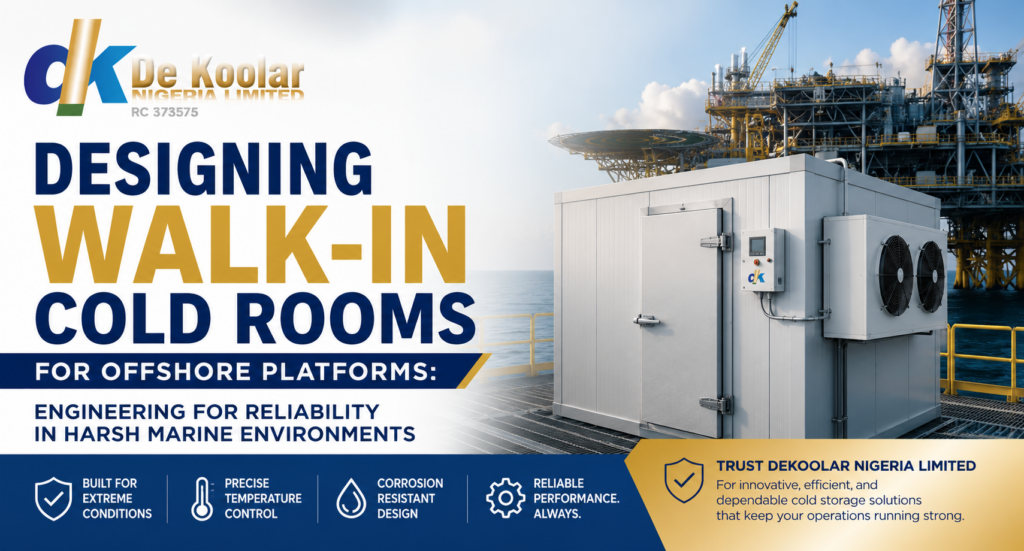
Offshore oil and gas platforms operate in some of the most challenging environments on earth. Every piece of equipment installed onboard must be capable of delivering consistent performance despite exposure to harsh weather conditions, salt-laden air, limited maintenance access, and continuous operation.
While systems such as power generation, water treatment, communications, and safety infrastructure often receive significant engineering attention, cold storage facilities are equally essential to offshore operations. Walk-in cold rooms support crew welfare, preserve food supplies, protect pharmaceuticals, and maintain temperature-sensitive materials required for daily operations.
Unlike conventional commercial refrigeration systems, offshore cold rooms must be specifically engineered to withstand the realities of marine environments while maintaining precise temperature control and energy efficiency. A refrigeration failure offshore can result in food spoilage, operational disruption, increased costs, and compliance challenges.
At De Koolar Nigeria Limited, we understand that effective cold storage solutions are not simply about refrigeration, they are about reliability, resilience, and long-term performance. This article explores the critical engineering considerations involved in designing walk-in cold rooms for offshore platforms and why specialized design is essential for successful offshore operations.
Why Offshore Platforms Require Walk-In Cold Rooms
Offshore facilities often operate hundreds of kilometers from shore, making frequent resupply impractical and expensive. Depending on the location and logistics schedule, food, medical supplies, and operational materials may need to be stored for several weeks or even months.
A properly designed offshore cold room helps operators:
- Preserve fresh and frozen food supplies for crew members.
- Maintain the integrity of pharmaceuticals and medical products.
- Store laboratory samples and temperature-sensitive materials.
- Minimize food waste and inventory losses.
- Improve operational efficiency.
- Support compliance with food safety and health regulations.
- Enhance crew welfare and productivity.
Reliable refrigeration directly contributes to business continuity and operational success in offshore environments.
Understanding the Unique Challenges of Offshore Environments
Designing cold rooms for offshore facilities requires a deep understanding of the environmental factors that affect equipment performance.
High Humidity Levels
Marine environments are characterized by consistently high humidity. Excess moisture can lead to condensation, corrosion, mold growth, and ice formation within refrigeration systems.
To combat these challenges, offshore cold rooms should incorporate:
- High-performance vapor barriers.
- Moisture-resistant insulation systems.
- Anti-condensation door heaters.
- Effective drainage systems.
- Proper air circulation strategies.
Failure to address humidity issues can significantly reduce system efficiency and shorten equipment lifespan.
Salt-Laden Air and Corrosion Risks
One of the biggest threats to offshore refrigeration systems is corrosion caused by salt exposure.
Without appropriate protection, critical components can deteriorate rapidly, resulting in increased maintenance costs and unexpected equipment failures.
To improve durability, offshore cold rooms should utilize:
- Marine-grade stainless steel surfaces.
- Corrosion-resistant evaporator coatings.
- Protective condenser finishes.
- Non-corrosive fasteners and structural supports.
- Specialized anti-rust treatments.
Selecting corrosion-resistant materials from the outset significantly extends the lifespan of refrigeration equipment.
Space Constraints
Every square meter onboard an offshore platform is valuable.
Cold storage facilities must maximize storage capacity while maintaining accessibility, safety, and operational efficiency.
Effective design strategies include:
- Modular cold room construction.
- Optimized shelving configurations.
- Strategic door placement.
- Compact refrigeration equipment.
- Vertical storage solutions.
A well-designed layout can substantially improve storage efficiency without increasing the facility footprint.
Selecting the Right Temperature Zones
Not all products require the same storage conditions. A professionally designed offshore cold storage facility often includes multiple temperature-controlled zones to accommodate different products.
| Storage Type | Recommended Temperature |
|---|---|
| Frozen Foods | -18°C to -25°C |
| Chilled Foods | 0°C to +4°C |
| Fresh Produce | +4°C to +8°C |
| Dairy Products | +2°C to +4°C |
| Pharmaceuticals | +2°C to +8°C |
Proper zoning not only preserves product quality but also improves energy efficiency by reducing unnecessary cooling loads.
Refrigeration System Design Considerations
The refrigeration system is the heart of any cold room installation. Offshore applications require equipment that balances cooling performance, reliability, energy efficiency, and maintainability.
Accurate Cooling Load Calculations
One of the most common causes of refrigeration inefficiency is incorrect system sizing.
Engineers should evaluate:
- Room dimensions.
- Product load volumes.
- Frequency of door openings.
- Ambient temperature conditions.
- Internal heat gains.
- Lighting loads.
- Occupancy patterns.
- Equipment operating within the cold room.
Accurate load calculations ensure the system performs efficiently without excessive energy consumption.
Energy Efficiency Matters Offshore
Power generation offshore is expensive.
Every kilowatt saved contributes directly to operational cost reduction and sustainability goals.
Energy-efficient cold rooms often include:
- High-efficiency compressors.
- Variable speed drives (VSDs).
- Electronic expansion valves.
- Intelligent temperature controls.
- LED lighting systems.
- High-performance insulation panels.
Investing in energy-efficient refrigeration systems can generate substantial long-term savings throughout the facility lifecycle.
The Importance of Redundancy and Reliability
Offshore operators cannot afford prolonged refrigeration failures.
For critical applications, redundancy should be integrated into the cold room design.
Common approaches include:
- Dual refrigeration circuits.
- Backup compressors.
- Emergency power integration.
- Remote alarm systems.
- Automated fault detection.
- Standby cooling systems.
These measures improve operational resilience and reduce the risk of costly downtime.
Insulation: The Foundation of Cold Room Performance
Insulation plays a major role in maintaining temperature stability and minimizing energy consumption.
Recommended insulation solutions include:
- High-density polyurethane insulated panels.
- Vapor-tight panel joints.
- Fire-rated insulation systems where required.
- Appropriate panel thickness based on operating temperature.
Quality insulation reduces compressor workload, lowers energy costs, and extends equipment life.
Door Design for Offshore Applications
Cold room doors are among the most frequently used components in any facility.
Because of constant use, they must be engineered for durability and efficiency.
Important features include:
- Heavy-duty hinges.
- Self-closing mechanisms.
- Heated door frames.
- Corrosion-resistant hardware.
- Durable sealing gaskets.
- Emergency safety release systems.
Proper door design minimizes cold air loss while improving safety and reliability.
Smart Monitoring and Automation
Modern offshore cold rooms increasingly utilize digital technologies to improve performance and maintenance planning.
Advanced monitoring systems may include:
- Continuous temperature logging.
- Cloud-based reporting.
- Remote monitoring capabilities.
- High-temperature alarms.
- Door-open notifications.
- Predictive maintenance analytics.
These technologies help operators identify potential issues before they result in costly failures.
Hygiene and Food Safety Considerations
Food safety is a critical requirement for offshore facilities.
Cold room designs should support easy cleaning and sanitation procedures through:
- Smooth washable surfaces.
- Hygienic shelving systems.
- Rounded internal corners.
- Proper drainage systems.
- Easy-to-clean evaporators.
A hygienic cold room reduces contamination risks and supports compliance with international food safety standards.
Maintenance Planning for Remote Offshore Operations
Unlike onshore facilities, maintenance opportunities offshore may be limited and expensive.
For this reason, maintenance accessibility should be incorporated during the design stage.
Best practices include:
- Accessible refrigeration components.
- Modular equipment layouts.
- Standardized spare parts.
- Remote diagnostic capabilities.
- Preventive maintenance programs.
Maintenance-friendly designs reduce downtime, improve reliability, and lower lifecycle costs.
The Business Value of Proper Offshore Cold Room Design
A well-engineered offshore cold room provides benefits that extend far beyond refrigeration.
Organizations can achieve:
- Reduced food spoilage.
- Improved crew welfare.
- Lower operating costs.
- Greater energy efficiency.
- Extended equipment lifespan.
- Enhanced regulatory compliance.
- Reduced maintenance expenses.
- Increased operational reliability.
For offshore operators, investing in quality refrigeration infrastructure is ultimately an investment in operational resilience and business continuity.
Why Partner with De Koolar Nigeria Limited?
Designing cold rooms for offshore facilities requires specialized engineering expertise, industry knowledge, and a deep understanding of industrial refrigeration systems.
At De Koolar Nigeria Limited, we design, install, and maintain high-performance cold storage and refrigeration solutions tailored to demanding industrial environments. Our team combines technical expertise, quality equipment, and proven engineering practices to deliver reliable temperature-controlled facilities that meet operational, safety, and efficiency requirements.
Whether supporting food preservation, pharmaceutical storage, or industrial process cooling, we develop refrigeration solutions built to perform consistently in even the harshest environments.
Offshore platforms present some of the most demanding conditions for refrigeration infrastructure. High humidity, corrosive salt exposure, limited maintenance access, and continuous operational requirements mean that conventional cold room designs are often insufficient.
Successful offshore cold room projects require a comprehensive engineering approach that prioritizes corrosion resistance, energy efficiency, reliability, temperature stability, and ease of maintenance.
As offshore operators continue to focus on sustainability, operational efficiency, and crew welfare, purpose-built walk-in cold rooms will remain a critical component of modern offshore infrastructure.
By investing in professionally engineered refrigeration solutions, organizations can improve operational continuity, protect valuable inventory, and ensure long-term performance in challenging marine environments.