
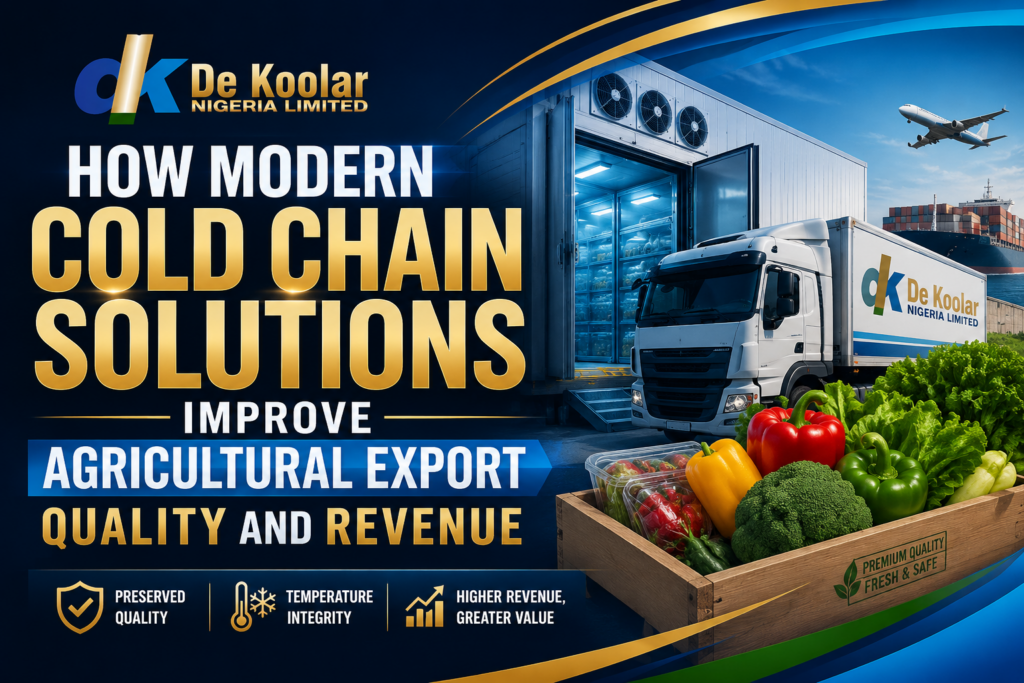
Agriculture remains a major contributor to economic growth, employment, and foreign exchange earnings. However, a significant portion of agricultural produce never reaches international markets in optimal condition due to inadequate storage and transportation systems.
For exporters, governments, investors, and agribusiness operators, modern cold chain infrastructure has become a critical tool for reducing losses, improving product quality, and increasing export revenue.
What Is a Modern Cold Chain?
A cold chain is a temperature-controlled system that preserves perishable products from harvest to final destination.
Key Components
| Component | Function |
|---|---|
| Pre-cooling Systems | Rapidly remove field heat after harvest |
| Cold Rooms | Maintain product freshness during storage |
| Refrigerated Transport | Protect products during transit |
| Distribution Centers | Facilitate efficient handling and delivery |
| Monitoring Systems | Track temperature and performance in real time |
Modern cold chains combine refrigeration, automation, and data monitoring to ensure product quality throughout the supply chain.
Why Cold Chain Matters for Agricultural Exports
Agricultural products begin to deteriorate immediately after harvest. Without proper temperature control, exporters face:
- Product spoilage
- Reduced shelf life
- Quality degradation
- Export shipment rejection
- Revenue losses
Products that heavily depend on cold chain infrastructure include fruits, vegetables, seafood, meat, dairy products, flowers, and pharmaceuticals.
How Modern Cold Chain Solutions Improve Export Quality
1. Reduce Post-Harvest Losses
Proper storage conditions significantly reduce spoilage and waste, ensuring more products remain suitable for export.
2. Preserve Freshness and Product Integrity
Cold chain systems maintain product appearance, texture, taste, and nutritional value from farm to market.
3. Extend Shelf Life
Longer shelf life allows exporters to access distant markets while maintaining product quality upon arrival.
4. Ensure Compliance with Global Standards
Temperature-controlled storage and transportation help businesses meet international food safety and quality requirements.
How Cold Chain Infrastructure Increases Revenue
| Benefit | Revenue Impact |
|---|---|
| Reduced Spoilage | More products available for sale |
| Improved Quality | Higher selling prices |
| Access to Premium Markets | Greater export opportunities |
| Better Buyer Confidence | Increased repeat business and contracts |
Rather than increasing production alone, reducing losses often provides a faster path to improving profitability.
Benefits for Governments, Investors, and Development Partners
Modern cold chain infrastructure delivers value beyond individual businesses.
| Stakeholder | Key Benefit |
|---|---|
| Government Agencies | Increased export earnings and food security |
| Foreign Investors | Reduced operational risk and stronger returns |
| Development Organizations | Lower food losses and improved livelihoods |
| Industrial Operators | Greater efficiency and supply chain reliability |
| FMCG & Pharmaceutical Companies | Product integrity and regulatory compliance |
Investing in cold chain infrastructure strengthens national competitiveness and supports economic diversification.
The Role of Technology
Today’s cold chain systems are increasingly powered by technology, including:
- IoT-enabled temperature monitoring
- Automated alerts and reporting
- Predictive maintenance systems
- Energy-efficient refrigeration solutions
- Data analytics for operational optimization
These innovations improve reliability while reducing operating costs.
Key Considerations Before Investing
Decision-makers should evaluate:
- Storage capacity requirements
- Product-specific temperature needs
- Compliance requirements for target export markets
- Energy efficiency and operating costs
- Scalability for future growth
A well-designed cold chain system should support both current operations and long-term expansion.
Modern cold chain infrastructure is no longer optional for export-focused agricultural businesses. It is a strategic investment that helps preserve product quality, reduce post-harvest losses, improve market access, and increase revenue.
For governments, investors, exporters, and industrial operators, the ability to maintain product quality from farm to market can be the difference between lost opportunities and sustainable growth.
By investing in modern cold chain solutions, stakeholders can unlock higher export earnings, strengthen global competitiveness, and build more resilient agricultural value chains.
About Dekoolar Nigeria Limited
Dekoolar Nigeria Limited provides innovative cold storage and cold chain solutions that help businesses and institutions preserve product quality, reduce losses, and maximize returns across agriculture, food processing, pharmaceuticals, and industrial sectors.