
What Happens When Food Has Nowhere to be preserved?
Imagine a fish farmer harvesting tons of fresh fish after months of hard work, only to watch a significant portion spoil before reaching the market.
Picture a fruit producer struggling to maintain product freshness during transportation, or an exporter losing access to lucrative international markets because products cannot meet quality standards upon arrival.
Unfortunately, these scenarios are not uncommon in Nigeria.
Every year, millions of tons of agricultural produce are lost due to inadequate cold storage facilities, unreliable preservation systems, and weak cold chain networks. These losses affect farmers, food processors, distributors, retailers, exporters, and ultimately consumers.
The consequences are far-reaching:
- Reduced income for farmers and agribusinesses
- Higher food prices for consumers
- Increased food waste
- Limited export opportunities
- Reduced food security
As Nigeria’s agricultural sector continues to expand, one critical question remains:
How do we preserve more of what we produce?
The answer lies in building stronger cold chain infrastructure.
That is exactly what is taking shape in Epe, Lagos State.
A Landmark Cold Storage Development is rising in Epe
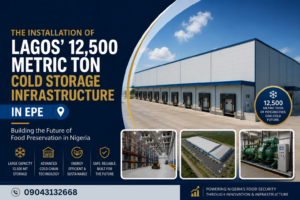
Nestled within one of Lagos State’s fastest-growing agricultural and aquaculture corridors, a massive 12,500 Metric Ton Cold Storage Infrastructure is currently under installation.
More than just a storage facility, this project represents a strategic investment in Nigeria’s agricultural future.
Designed to support food preservation, reduce post-harvest losses, and improve export readiness, the facility is expected to become one of the most significant cold chain hubs in the region.
When completed, it will provide businesses with access to large-scale temperature-controlled storage capable of preserving a wide range of perishable products.
For producers and distributors, this means longer shelf life.
For exporters, it means better market access.
For Nigeria, it means a stronger and more resilient food system.
Why Epe?
Location matters in cold chain logistics.
Epe has emerged as one of Lagos State’s most important agricultural and seafood production zones. The region supports:
- Fish farming and aquaculture
- Poultry production
- Fruit cultivation
- Vegetable farming
- Food processing activities
- Agricultural aggregation and distribution
Its proximity to major commercial markets, transportation routes, and export channels makes it an ideal location for a large-scale cold storage facility.
Rather than transporting products over long distances before preservation, businesses can access storage closer to production areas, helping maintain product quality and reduce losses.
This strategic positioning will help strengthen the entire agricultural value chain.
Understanding the Cold Chain: Why Storage Matters
Many people associate food production solely with farming.
However, producing food is only half the journey.
The other half is preserving it.
A cold chain is a temperature-controlled supply system designed to maintain product quality from harvest to consumption.
Without proper refrigeration, products such as fish, poultry, fruits, vegetables, dairy products, and processed foods begin to deteriorate rapidly.
Even a few hours of exposure to high temperatures can result in:
- Quality degradation
- Reduced shelf life
- Food waste
- Financial losses
- Food safety concerns
This is why modern cold storage facilities have become essential infrastructure for countries seeking to strengthen food security and agricultural competitiveness.
A 12,500 Metric Ton Vision Taking Shape
The scale of this project reflects the growing demand for reliable cold storage solutions across Nigeria.
Once completed, the facility will provide storage capacity for up to 12,500 metric tonnes of temperature-sensitive products.
That means thousands of tonnes of food can be safely preserved while awaiting processing, distribution, retail sale, or export.
The facility is being developed with a focus on efficiency, reliability, and long-term operational performance.
Advanced Refrigeration Technology for Reliable Preservation
At the heart of every successful cold storage facility is its refrigeration system.
The Epe Cold Storage Infrastructure incorporates modern refrigeration technologies designed to ensure:
- Reliable temperature control
- Consistent product preservation
- Operational efficiency
- Reduced spoilage
- Long-term system reliability
Maintaining precise temperatures is critical for preserving product quality and extending storage life.
This technological foundation will help businesses confidently store products while maintaining freshness and safety standards.
Supporting Multiple Industries under One Roof
One of the key strengths of the facility is its versatility. The infrastructure is designed to accommodate a wide range of products, including:
- Seafood and Fish Products
Supporting Nigeria’s growing aquaculture industry.
- Poultry Products
Helping poultry producers preserve inventory and stabilize supply.
- Fruits and Vegetables
Extending shelf life and reducing seasonal losses.
- Dairy Products
Maintaining freshness and product integrity.
- Frozen Foods
Providing reliable storage for distributors and retailers.
- Processed Food Products
Supporting manufacturers requiring temperature-controlled storage.
- Export Commodities
Helping exporters meet international quality standards. This multi-product capability makes the facility a valuable asset for numerous sectors of the economy.
Unlocking Nigeria’s Export Potential
Nigeria possesses enormous agricultural export opportunities.
However, global markets demand more than production volume.
International buyers expect products that meet strict requirements for:
- Freshness
- Quality consistency
- Food safety
- Shelf life
- Traceability
Without adequate cold storage infrastructure, valuable export opportunities can be lost before products even leave the country.
The Epe Cold Storage Infrastructure is being developed to help bridge this gap.
By providing reliable preservation capacity, the facility will support export-oriented supply chains and help Nigerian businesses compete more effectively in international markets.
Creating Value across the Agricultural Supply Chain
The impact of this project extends far beyond storage. It has the potential to create benefits for every stakeholder within the food value chain.
- For Farmers
Farmers will have greater opportunities to preserve harvested products and reduce avoidable losses.
- For Food Processors
Reliable storage can help improve inventory management and production planning.
- For Distributors
Products can remain fresher for longer, reducing spoilage during distribution.
- For Retailers
Improved product quality and availability can enhance customer satisfaction.
- For Exporters
Access to modern cold storage improves compliance with international trade requirements.
Strengthening Food Security through Infrastructure
Food security is often discussed in terms of increasing production. Yet preservation is equally important. Every kilogram of food saved from spoilage contributes to:
- Improved food availability
- Reduced waste
- Better resource utilization
- Stronger supply chains
- Enhanced economic returns
Investing in cold chain infrastructure is therefore an investment in national food security.
Projects like the Epe Cold Storage Infrastructure play a crucial role in ensuring that more food reaches consumers rather than being lost after harvest.
Economic Benefits beyond Refrigeration
Large-scale infrastructure projects generate economic impact far beyond their primary function. Upon completion, the facility is expected to support:
Employment Creation
Generating opportunities in:
- Construction
- Refrigeration engineering
- Logistics
- Facility operations
- Maintenance services
Agricultural Growth
Providing confidence for farmers, agribusinesses, and investors.
Export Expansion
Supporting Nigeria’s participation in regional and international food markets.
Private Sector Development
Enabling businesses to scale efficiently through access to critical infrastructure.
More Than a Building—A Foundation for the Future
As installation continues, the 12,500 Metric Ton Cold Storage Infrastructure in Epe represents more than steel, insulation panels, and refrigeration equipment.
- It represents a commitment to reducing food waste.
- It represents a stronger cold chain ecosystem.
- It represents greater opportunities for farmers, processors, distributors, and exporters.
- Most importantly, it represents a future where Nigeria can preserve more of what it produces and unlock the full potential of its agricultural sector.
- The future of food preservation is not a distant vision.
- It is being built today in Epe, Lagos and its impact will be felt far beyond its walls.